
What is algorithmic trading? A 2026 guide for traders
Many traders mistakenly believe algorithmic trading is only for high-frequency programmers with advanced coding skills. In reality, algorithmic trading now includes customizable, adaptive strategies applicable across futures, stocks, and ETFs, accessible to professional traders at all technical levels. This guide will clarify fundamentals, advanced methods, and implementation best practices to empower you with clear, actionable insights into modern algorithmic trading strategies.
Table of Contents
- Introduction To Algorithmic Trading
- How Algorithmic Trading Works: Mechanisms And Execution
- Role Of Machine Learning And AI In Algorithmic Trading
- Comparison Of Classic Rule-Based Vs AI-Driven Strategies
- Customization And Implementation Of Algorithmic Trading Strategies
- Risk Management And Market Stability In Algorithmic Trading
- Common Misconceptions About Algorithmic Trading
- Performance Verification And Backtesting Best Practices
- Explore Custom Algorithmic Trading Tools From Trader Algorítmico
Key takeaways
| Point | Details |
|---|---|
| Algorithmic trading automates trades removing human emotion for higher precision | Automated execution follows predefined rules consistently, eliminating fear and greed from decision-making. |
| Machine learning enhances adaptability over classic rule-based systems for better returns | AI models adjust strategies dynamically based on evolving market conditions, improving risk-adjusted performance. |
| Risk management frameworks are essential to control losses and ensure stability | Multi-layered controls including drawdown limits and stop-loss algorithms protect capital during volatile periods. |
| Customization for futures, stocks, and ETFs tailors strategies to asset-specific behaviors | Strategies adapt to liquidity, volatility, and market depth characteristics unique to each asset class. |
| Backtesting and performance verification are critical prior to live deployment | Rigorous multi-regime testing validates robustness and prevents overfitting before risking real capital. |
Introduction to algorithmic trading
Algorithmic trading uses pre-programmed computer instructions to execute trades automatically based on predefined rules, removing emotion and human error. This approach delivers consistent execution across futures, stocks, and ETFs by analyzing and acting on multiple simultaneous market signals. The benefits include faster execution speed, reduced bias, and improved consistency compared to manual trading methods.
Algorithms process market data continuously, monitoring price action, order flow, and market depth to identify optimal entry and exit points. When predefined conditions are met, the system executes trades instantly without hesitation or second-guessing. This automation eliminates the delays and emotional interference that plague manual traders during volatile market conditions.
Professional traders apply algorithmic strategies across diverse asset classes, adapting rules to match each market’s unique characteristics. Futures markets benefit from strategies optimized for high leverage and continuous trading hours. Stock algorithms account for opening gaps and after-hours volatility. ETF strategies leverage basket arbitrage opportunities and sector rotation patterns.
Key advantages of algorithmic trading include:
- Simultaneous monitoring of unlimited instruments and timeframes
- Instant order execution when conditions align precisely
- Elimination of emotional decision-making during drawdowns
- Consistent application of proven trading rules without deviation
- Ability to backtest strategies across years of historical data
Exploring top 5 algorithmic trading strategies that actually work reveals how professionals implement these principles across different market environments. Understanding these foundational concepts prepares you to build robust automated systems tailored to your specific trading objectives and risk tolerance.
How algorithmic trading works: Mechanisms and execution
Algorithmic trading systems operate through a structured process that transforms market data into executed trades with minimal human intervention. Algorithms can process thousands of signals simultaneously for execution speed and precision, far exceeding human capabilities. Understanding these operational mechanisms helps you design more effective automated strategies.
The execution process follows these essential steps:
- Data ingestion captures real-time market information including price, volume, and order book depth
- Signal generation analyzes data against predefined rules to identify trading opportunities
- Order creation builds specific instructions for trade size, price, and timing
- Execution routing sends orders to exchanges through low-latency connections
- Position monitoring tracks open trades and adjusts orders based on changing conditions
- Performance logging records all actions for analysis and strategy refinement
Low latency technology forms the backbone of effective algorithmic execution. Modern platforms connect directly to exchange servers, reducing order transmission time to microseconds. This speed advantage proves critical when competing for liquidity at favorable price levels or capturing fleeting arbitrage opportunities.

Market data inputs drive algorithmic decision-making through multiple dimensions. Order flow reveals buying and selling pressure at different price levels. Price action patterns signal potential reversals or continuation moves. Market depth displays available liquidity across the order book, helping algorithms optimize trade sizing and timing.
Algorithms continuously modify orders based on live market feedback. If a large sell order appears above current price, the algorithm may tighten profit targets. When volatility expands suddenly, position sizing rules reduce exposure automatically. This dynamic adjustment maintains alignment with market reality without requiring manual intervention.
Learning about algorithmic trading mechanics and execution through comprehensive resources deepens your understanding of these complex systems. Mastering execution mechanics enables you to build strategies that capitalize on market inefficiencies while managing technical risks effectively.
Role of machine learning and AI in algorithmic trading
Machine learning represents the evolution beyond traditional rule-based algorithms by enabling adaptive, self-improving trading systems. Emerging AI-based models identify complex patterns and adapt strategies dynamically to improve risk-adjusted returns. These advanced approaches recognize subtle market relationships that escape static rule-based detection.
AI models analyze vast datasets to recognize patterns across multiple timeframes and instruments simultaneously. Neural networks process thousands of feature combinations, identifying non-linear relationships between market variables. Deep learning architectures detect regime changes before they become obvious through traditional indicators. This analytical depth provides significant advantages in crowded, efficient markets.
Adaptive algorithms adjust trading rules based on changing market conditions without manual reprogramming. When volatility regimes shift, machine learning models recalibrate risk parameters automatically. During trending periods, AI systems increase position sizes and widen stops. In choppy markets, algorithms reduce exposure and tighten profit targets dynamically.
Multi-strategy AI platforms combine diverse approaches for improved robustness:
- Trend-following models capture directional moves across multiple timeframes
- Mean reversion algorithms exploit temporary price dislocations
- Scalping strategies harvest small profits from bid-ask spreads
- Arbitrage systems identify pricing inefficiencies across related instruments
- Sentiment analysis models interpret news and social media data
Continuous learning helps mitigate performance degradation during market regime shifts. Traditional algorithms often fail when market structure changes, requiring complete redesign. Machine learning systems adapt incrementally, maintaining effectiveness across evolving conditions. This resilience proves valuable for long-term strategy deployment.
Pro Tip: Start with simpler rule-based strategies before implementing complex AI models. Master basic automation and risk management first, then gradually incorporate machine learning enhancements as you gain experience with algorithmic execution.
Implementing machine learning strategies in algo trading requires careful validation to prevent overfitting while capturing genuine market edges. Balancing model complexity with interpretability ensures you understand why your AI system makes specific trading decisions.
Comparison of classic rule-based vs AI-driven strategies
Classic rule-based strategies use deterministic rules with predictable outputs, while emerging AI-based models identify complex patterns and adapt strategies dynamically. Understanding the trade-offs between these approaches helps you select the right methodology for your trading objectives and technical capabilities.
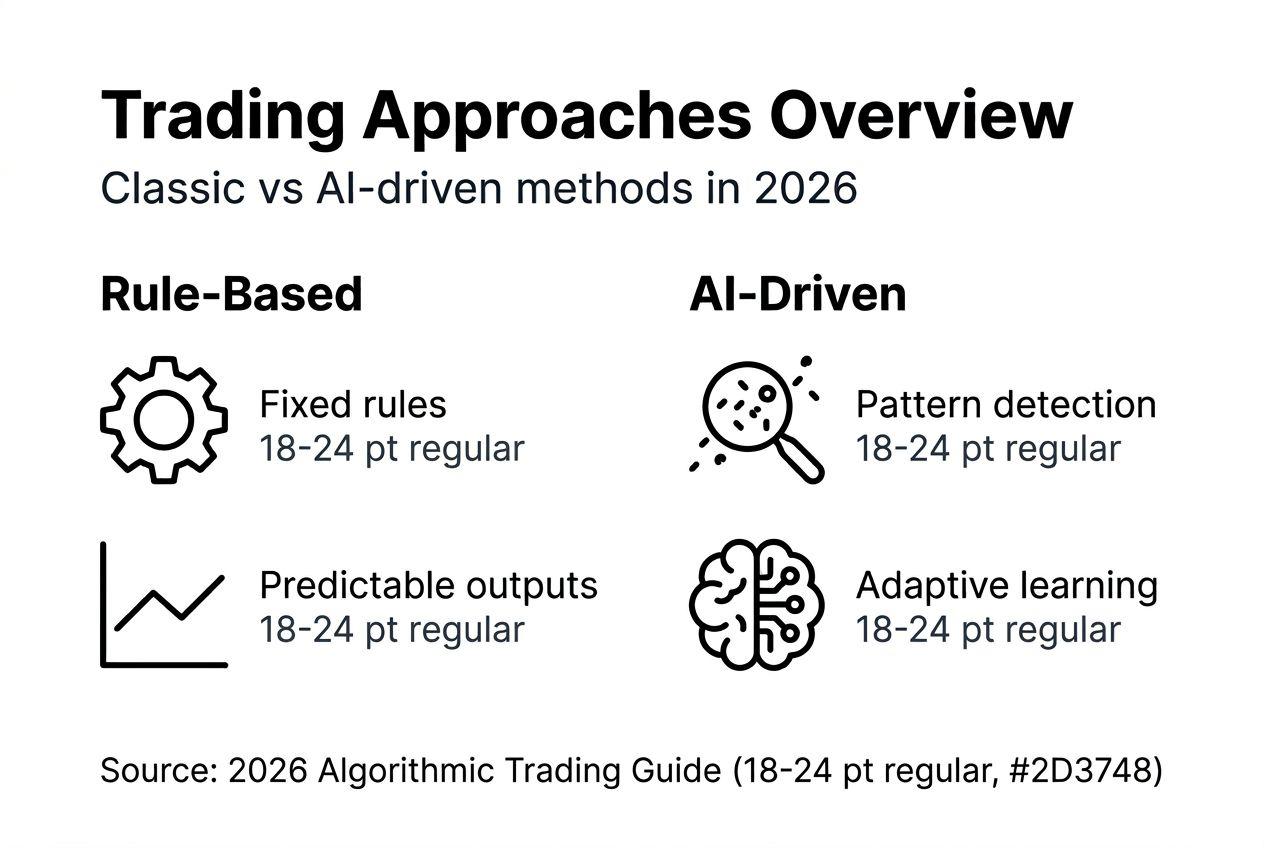
| Feature | Classic Rule-Based | AI-Driven |
|---|---|---|
| Logic transparency | Fully interpretable with clear if/then rules | Black box with complex non-linear relationships |
| Development complexity | Relatively simple requiring basic programming | Requires advanced data science and ML expertise |
| Adaptability | Static rules requiring manual updates | Dynamic adjustment to changing market conditions |
| Validation difficulty | Straightforward with clear pass/fail criteria | Complex requiring robust out-of-sample testing |
| Overfitting risk | Lower due to limited parameter space | Higher requiring careful regularization techniques |
| Performance ceiling | Limited by human insight and rule simplicity | Higher potential through pattern recognition |
| Market suitability | Effective in stable, predictable environments | Superior during regime changes and volatility |
Classic strategies rely on fixed, easy-to-understand indicators yielding predictable actions. A simple moving average crossover executes trades when short-term momentum exceeds long-term trends. Breakout systems enter positions when price exceeds recent highs or lows. These transparent rules make validation straightforward and debugging manageable.
AI-driven strategies detect subtle patterns invisible to traditional analysis. Machine learning models recognize that certain volume patterns precede directional moves only during specific volatility regimes. Neural networks identify relationships between seemingly unrelated instruments, enabling sophisticated arbitrage strategies. This pattern recognition capability offers superior adaptability but demands robust validation.
Traders must balance predictability with adaptability based on market context and objectives. Stable markets with consistent structure favor classic rule-based approaches. Volatile, rapidly evolving markets reward adaptive AI systems capable of recognizing regime changes. Many professional traders combine both methodologies, using classic rules for core positions and AI strategies for opportunistic trades.
Pro Tip: Begin with classic rule-based strategies to establish solid automation fundamentals and risk management discipline. Once you consistently profit from simpler approaches, gradually introduce AI components to specific strategy elements where adaptability provides clear advantages.
Examining classic vs AI-driven trading strategies across different market conditions reveals when each approach excels. This nuanced understanding enables you to architect hybrid systems leveraging the strengths of both methodologies.
Customization and implementation of algorithmic trading strategies
Tailoring algorithmic strategies for futures, stocks, and ETFs requires understanding each asset class’s unique liquidity and volatility characteristics. Successful implementation combines asset-specific customization with rigorous development and testing protocols. Professional traders optimize strategies to match their execution infrastructure and market access capabilities.
Futures markets demand strategies accounting for leverage, margin requirements, and nearly 24-hour trading. Order flow becomes critical during overnight sessions when liquidity thins. Market depth indicators help algorithms avoid slippage during rapid directional moves. Position sizing rules must account for contract multipliers and intraday margin changes.
Stock strategies consider opening gaps, earnings volatility, and sector rotation patterns. Algorithms monitor pre-market activity to anticipate opening direction. Volume profile analysis identifies key price levels where institutional orders cluster. Sector correlation filters prevent overconcentration in related instruments during market-wide moves.
ETF algorithms leverage basket arbitrage opportunities and creation/redemption mechanics. Strategies monitor underlying component prices for discrepancies with ETF market prices. Multi-leg orders capture spreads between related ETFs tracking similar indexes. Rebalancing patterns create predictable intraday flows that algorithms exploit.
Development steps for robust algorithmic strategies:
- Define quantifiable trading rules based on specific market observations
- Code strategy logic using platform-native language or visual tools
- Validate logic through paper trading in simulated environments
- Backtest across multiple market regimes and timeframes
- Optimize parameters using walk-forward analysis to prevent overfitting
- Deploy with conservative position sizing and tight risk controls
- Monitor live performance against backtested expectations continuously
Market depth and order flow indicators refine entries and exits significantly:
- Cumulative delta reveals institutional accumulation or distribution
- Bid-ask imbalance predicts short-term directional pressure
- Volume profile identifies high-probability support and resistance zones
- Order book depth signals potential slippage before trade execution
Reliable, low-latency execution infrastructure minimizes slippage and maximizes fill rates. Colocated servers reduce network latency to microseconds. Direct market access connections bypass intermediary routing delays. Smart order routing algorithms seek optimal execution across multiple venues simultaneously.
Resources for customizing and implementing algo trading strategies provide practical frameworks for development and deployment. Understanding strategy backtesting methods ensures your systems perform reliably before risking capital in live markets.
Risk management and market stability in algorithmic trading
Integrated risk management frameworks protect algorithmic trading systems from catastrophic losses while maintaining market stability. Multi-layered controls monitor exposure, drawdown, and execution quality continuously. Professional traders implement automated safeguards that adapt dynamically to changing market conditions.
Maximum drawdown limits prevent account-destroying losing streaks by halting trading when cumulative losses exceed predefined thresholds. Stop-loss algorithms exit positions automatically when adverse price moves reach critical levels. Position sizing rules scale exposure inversely with recent volatility, reducing risk during turbulent periods. These mechanical controls remove emotional decision-making during stressful market environments.
Real-time execution quality monitoring reduces latency-induced slippage through several mechanisms:
- Fill price analysis compares executed prices to expected levels
- Slippage tracking identifies problematic instruments or time periods
- Latency measurement ensures order transmission meets performance targets
- Rejection rate monitoring detects connectivity or infrastructure issues
Dynamic risk parameter adjustment maintains appropriate exposure across different market regimes. During high volatility periods, algorithms reduce position sizes and tighten stops automatically. In low liquidity environments, order sizes decrease to minimize market impact. Correlation monitoring prevents overconcentration when multiple positions move together unexpectedly.
Simulation and stress testing anticipate adverse scenarios before they occur in live trading. Monte Carlo analysis generates thousands of potential market paths, revealing strategy vulnerabilities. Historical stress tests replay extreme events like flash crashes or volatility spikes. Worst-case scenario planning establishes appropriate capital reserves and hedging strategies.
Proper risk management improves system longevity and preserves capital through inevitable drawdown periods. Algorithms with robust controls survive market disruptions that destroy poorly protected systems. Capital preservation enables compounding returns over time, the true source of long-term trading success.
Implementing comprehensive risk management in algorithmic trading separates sustainable professional operations from fragile systems vulnerable to market shocks. These protective frameworks provide confidence to maintain strategies during temporary adverse performance.
Common misconceptions about algorithmic trading
Widespread myths about algorithmic trading prevent many professional traders from adopting these powerful tools. Not all algorithmic trading is high-frequency and programming is not mandatory for beginners. Clarifying these misconceptions reveals algorithmic trading’s true accessibility and strategic diversity.
Key misconceptions and realities:
- Myth: Algorithmic trading requires advanced programming expertise. Reality: Low-code and no-code platforms enable strategy development through visual interfaces and pre-built modules.
- Myth: All algorithmic strategies are high-frequency scalping systems. Reality: Many algorithms trade infrequently, holding positions for hours, days, or weeks based on longer-term signals.
- Myth: Algorithmic trading guarantees consistent profits. Reality: Risk remains inherent; algorithms improve discipline and execution but cannot eliminate market uncertainty.
- Myth: Only institutional traders can afford algorithmic infrastructure. Reality: Retail platforms now offer professional-grade automation at accessible price points.
- Myth: Algorithms remove all human judgment from trading. Reality: Strategy design, parameter selection, and risk management require continuous human oversight and refinement.
Programming skills help but aren’t strictly required for effective algorithmic trading. Visual strategy builders allow drag-and-drop rule creation without coding. Pre-built strategy templates provide starting points for customization. Many successful algorithmic traders focus on market analysis and strategy logic rather than software development.
Algorithmic trading reduces emotional bias, improving trade discipline significantly. Automation prevents fear-based exits during temporary drawdowns. Greed-driven overtrading disappears when position sizing follows predefined rules. Consistency improves as algorithms execute identical logic regardless of recent performance or market conditions.
Misunderstandings about algorithmic trading lead to missed opportunities or poor implementation. Traders avoiding automation due to perceived complexity sacrifice significant advantages. Those implementing algorithms without proper understanding experience preventable failures. Accurate knowledge enables appropriate adoption decisions and effective strategy development.
Addressing common algorithmic trading misconceptions clears obstacles preventing professional traders from leveraging automation effectively. Understanding realistic capabilities and limitations sets appropriate expectations for algorithmic trading success.
Performance verification and backtesting best practices
Rigorous verification methods ensure algorithmic strategies perform reliably before live deployment. Multi-market and multi-timeframe backtesting reveals robustness across diverse conditions. Professional traders employ transparent metrics and validation protocols to avoid common pitfalls like overfitting that destroy live performance.
Comprehensive backtesting examines strategy performance across multiple dimensions:
- Different market instruments to verify adaptability
- Various timeframes from intraday to weekly charts
- Multiple years spanning different volatility regimes
- Both trending and range-bound market environments
- High and low liquidity periods to assess execution feasibility
Out-of-sample validation prevents overfitting by testing strategies on data not used during development. Reserve recent market data for final verification after strategy optimization. Walk-forward analysis progressively tests strategies on successive time periods, simulating real-world deployment. Cross-validation techniques from machine learning ensure statistical robustness.
Transparent risk-adjusted performance metrics provide comprehensive strategy evaluation. Sharpe ratio measures return per unit of volatility, favoring consistent performers. Sortino ratio focuses on downside deviation, rewarding strategies protecting capital during drawdowns. Maximum drawdown reveals worst-case loss potential, critical for position sizing decisions. Win rate and profit factor indicate strategy reliability and efficiency.
Continuous monitoring compares live trading results against backtested expectations. Performance divergence signals strategy degradation or changing market conditions. Slippage analysis identifies execution quality issues requiring infrastructure improvements. Correlation tracking detects unintended relationships between supposedly independent strategies.
Combine quantitative metrics with qualitative review of trade logic. Examine individual trades to verify algorithms execute as intended. Analyze losing trades to distinguish bad luck from flawed logic. Review winning trades to ensure profits derive from intended edges rather than fortunate accidents.
Mastering backtesting best practices separates sustainable algorithmic strategies from fragile systems vulnerable to live market conditions. These validation protocols build confidence before risking real capital on automated execution.
Explore custom algorithmic trading tools from Trader Algorítmico
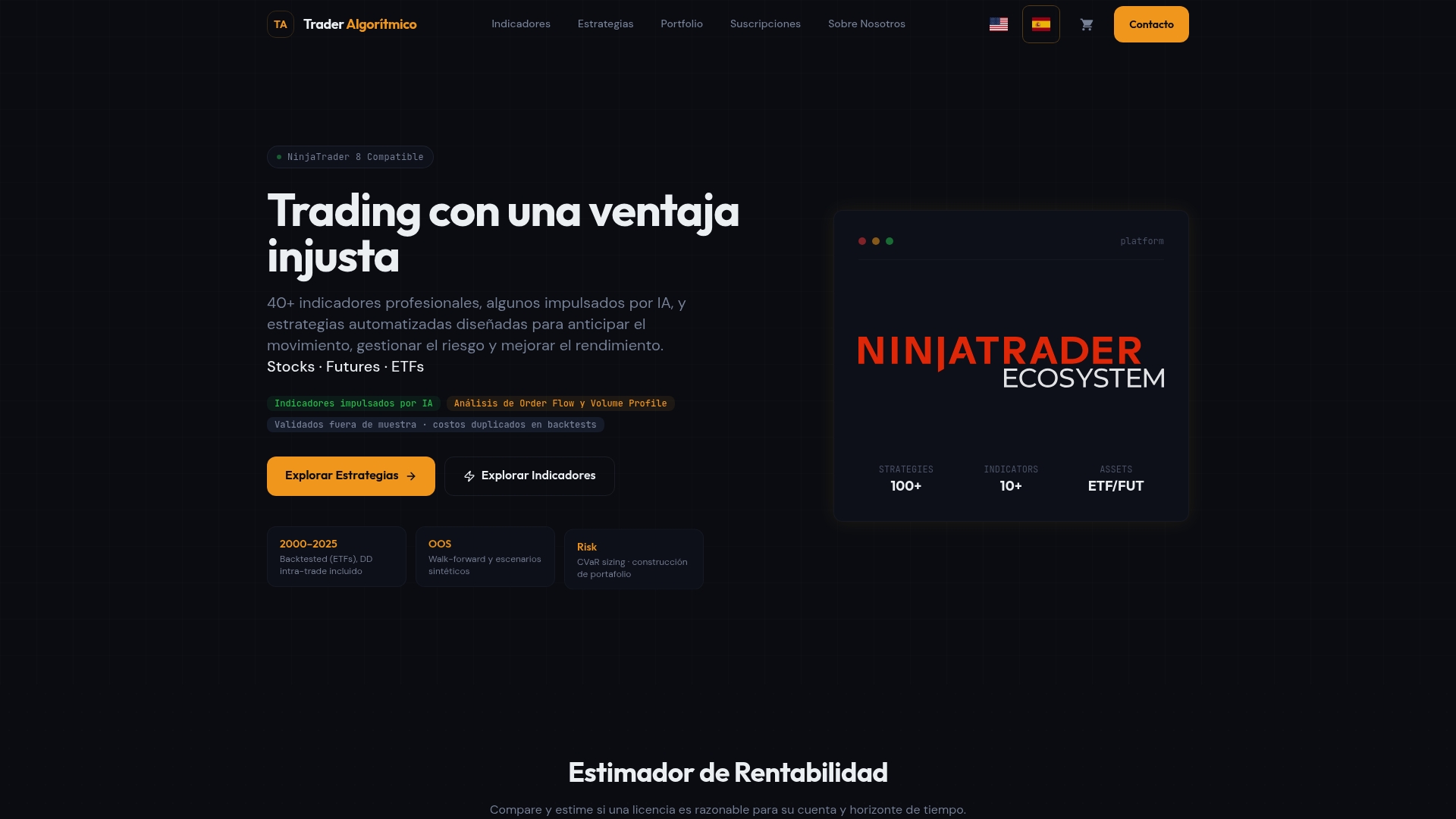
Now that you understand algorithmic trading fundamentals and best practices, implementing these strategies becomes the critical next step. Trader Algorítmico provides advanced, customizable tools designed specifically for professional algorithmic traders using NinjaTrader 8, enabling you to execute the strategies and principles discussed throughout this guide.
The order flow indicator delivers professional-grade market depth analysis with up to 200 levels, revealing institutional buying and selling pressure invisible to standard charts. This transparency helps your algorithms identify optimal entry and exit points based on real liquidity dynamics rather than lagging price action alone.
For fully automated execution, the Robotrader strategy provides a customizable algorithmic system with verified backtest results across multiple market conditions. Deploy breakout, trend-following, or scalping approaches with transparent performance metrics, adapting the system to your specific risk tolerance and trading objectives.
Enhance trend identification across futures, stocks, and ETFs with the Power Trend indicator, which filters noise and highlights high-probability directional moves. Seamlessly integrate these professional-grade tools within NinjaTrader 8 to elevate your algorithmic trading performance with solutions designed specifically for serious traders.
FAQ
What programming skills are required for algorithmic trading?
Many platforms now offer low-code or no-code options that enable strategy development through visual interfaces. Programming is not mandatory for beginners due to availability of these accessible tools. Basic programming helps optimize custom strategies but isn’t a strict requirement for implementing effective algorithmic systems.
How does algorithmic trading reduce emotional bias?
Algorithmic trading automates decisions based on predefined rules, removing fear and greed which cause many manual trading losses. Automation follows pre-set rules consistently without impulsive decisions during volatile periods. This mechanical approach improves trade discipline and consistency over time, eliminating emotional interference that plagues discretionary traders.
What are common pitfalls in backtesting algorithmic strategies?
Overfitting to historical data leads to unrealistic results that fail in live markets. Ignoring out-of-sample tests reduces reliability by validating strategies only on data used during development. Neglecting transaction costs and market impact skews performance significantly, making profitable backtests unprofitable live. Failing to test across multiple market regimes causes fragility when conditions change, as detailed in resources about common backtesting pitfalls.
Can algorithmic trading work for retail traders with limited capital?
Algorithmic trading proves accessible for retail traders through affordable platforms and fractional position sizing. Modern automation tools start at low price points with professional-grade capabilities. Strategies scale effectively from small to large accounts by adjusting position sizes proportionally. The key advantage lies in execution discipline and consistency rather than capital size, making algorithmic approaches valuable regardless of account balance.
How do I choose between trend-following and mean reversion algorithms?
Market conditions and personal risk tolerance determine optimal strategy selection. Trend-following algorithms excel during sustained directional moves with clear momentum. Mean reversion strategies profit in range-bound, choppy markets where prices oscillate around equilibrium. Many professional traders deploy both approaches simultaneously, allocating capital based on current volatility regime. Testing both methodologies on your target instruments reveals which approach aligns best with historical market behavior.



Leave a Reply
Want to join the discussion?Feel free to contribute!